
Ill Communication Podcast, Episode 183
I think we need to normalize that success doesn't always look like a million-dollar launch.
In fact, it is very rare.
We're in an era where a lot of us are feeling the pinch of the increased cost of living. Sales have felt a little more sluggish and slow.
And at the same time, there have been several MASSIVE launches in the online business world. Callan Faulkner had a $20.7 million launch of her AI training suite. Jessi Jean generated $7.5 million to teach you how to film yap videos on Instagram. Jessica Carter generated $1.15 million in 2.5 months with digital courses.
If I'm being honest, I've found all of this quite triggering, but in a different way.
I love that these women are selling their hearts out. It is evidence that an abundance of opportunity still exists in 2026.
And I also look at my own business and wonder why I haven't had that level of success?
The answer is, I haven't worked towards it. I don't yap on Instagram. I don't shoot b-roll. I don't have a team of 70 people (like Callan Faulkner). And that’s a deliberate choice I've made.
And so I think it's also important to see what success looks like when you intentionally choose to run a lean, boutique, high-touch business, where the dollar amounts are much smaller but the wins are no less meaningful.
So today I want to share the best thing I did for my business in 2026.
Drum roll please.

» It’s just a good old fashioned webinar funnel.
The webinar experiment
This year I aimed to host a monthly webinar. It's something I've wanted to do for a very long time. I have taken multiple courses and coaching programs, and spent literally tens of thousands of dollars learning how to do webinars. But when I was in those programs, I never actually executed on what I was learning.
In January 2026, I decided enough was enough. And so I launched a masterclass webinar called the Premium Pipeline Strategy, with an invitation to join my group messaging program, Pivot to Premium.
I ended up running only 7 webinars in 2026. My goal had been to run a monthly webinar, and I only ran 7, because on the months I didn't, I was engaged in another teaching opportunity, like a summit or a guest expert session. So about every month I had some kind of monthly marketing moment going on.
With this particular experiment, I ran Meta ads to cold audiences in the 2 weeks leading up to 5 of the 7 webinars. The other 2 I promoted to my email list only.
And I have to say, I was pretty impressed with how effective my ads were.
The cost per lead
I took a look at the latest data, and the average cost per lead across the industry, is $27.66 USD.
That average is across a range of industries: restaurants are at the low end at about $3 per lead, and dentists and dental services are at the high end at $76.71 per lead.
My masterclass and offer falls under the Education and Instruction category, which sees an average Meta ad cost per lead of $28.22.
So, hold on to your period panties when I tell you what my cost per lead was.
My costs ranged from $7.13 to $12.18, for an average of $8.49 per lead. But my costs are in Canadian currency. When I convert to U.S. dollars, my average cost per lead was just $5.96!
That is incredibly low.
It's because I nailed the messaging and positioning in my ads.
I was hyper-specific in both my targeting and in my ad copy that I work with Gen Xers who are frustrated with playing the social media game, who feel like the marketing advice doesn't work for them, and who know they should be generating way more revenue than they're generating.
When people signed up, I asked what led them to sign up today. They wrote things like, "You're speaking my language." "I can't stand the advice out there." "Your ad really spoke to me." That kind of voice of customer told me that my message was landing.
Ad spend, sign-ups and the landing page
In terms of ad spend, I set a limit of about $1,000 to $1,500 per campaign. For each webinar I hosted, I spent about a thousand bucks on ads. In total, I spent $6,105.92 on Meta ads in 2026.
Ads brought me 100 to 200 sign-ups per webinar. And added about 837 people to my email list over the course of the year.
Which begs the next question: how did my masterclass registration page convert?
I'm gonna be honest. I think it was okay. It was nothing crazy.
My landing page converted at 28%, which means 28% of the people who clicked the ad went to my landing page and signed up. I'm selling this masterclass to a totally cold audience, people who've never heard of me before.
When I compared that with the industry average, it was actually pretty good. According to Leadpages, webinar registration pages for B2B audiences convert between 20% and 40% for well-targeted traffic. So at 28%, I'm kind of right in the middle.
According to WordStream, conversion rates in the Education and Instruction category are 13%. Given that, I'm more than okay with my numbers, especially since this was my first attempt at running a webinar funnel with cold traffic.
You can check out my landing page at kimkiel.com/pipeline. And while you're there, sign up for the last masterclass I'll be hosting this year!
Let’s look at my (measly?) sales
So… how many sales did I get?
I assure you it wasn't anywhere close to a million, or even a hundred thousand dollars. I'm keeping it real, and I feel pretty vulnerable telling you that across all the webinars I hosted, I closed 7 sales.
Cue: sad trombone <Wah-wah>.
I know, that sounds so low. But if you zoom out, it's also not that bad.
Of the 7 webinars I hosted, 4 generated sales, and those sales were with ideal premium clients. Beautifully aligned clients who hopped on sales calls and were like, "I'm in." Women I feel lucky to work with, who are so niched in their expertise, so incredibly talented, and who deliver tremendous value to this world. And they chose to work with me to help them amp up their messaging and sales.
And remember, many of these sales were with people who had never heard of me before they saw an ad. They clicked an ad, watched a webinar, and bought my high-ticket offer, which is priced at $2,000 for 4 months, or $4,800 for the full year.
Those 7 sales generated $33,800 for my business. That’s not chump change!
And remember, I spent $6,105.92 on ads. Which turned into $34,000 in revenue, and means I had a return on ad spend (ROAS) of 5.5.
For every $1 I plugged into Meta, I received 5.5 times my money back!
That's an insane return rate.
For comparison, average ROAS, or return on ad spend, across all industries is around 2.8. In my category of education and training, the industry average is only 1.8.
I feel pretty dang good about 5.5x-ing my investment in ads!
The other kind of ROI
But here's the thing I really want to share with you.
These sales felt so easy. I found running and managing the ads was so easy and fun, and I'll shout out my tech wingwoman Lacey, who helped me a lot with it. Delivering the product and service was also so easy and joyful. Working with clients inside Pivot to Premium is the work that lights me up the most.
So not only was there a mathematical return on investment, a financial return on investment, there was also a massive ROI in terms of the joy and delight I felt for my business again. I felt like I was in control and taking action, even if I was “only” running a monthly or a near-monthly webinar.
What's my plan for 2027?
Well, I'm not expecting to stop running ads or stop doing webinars. In fact, there's a pretty good likelihood I'll double down on that even more. I'm going to create a better sales page, and I'm probably going to refresh the messaging and targeting and the registration page.
And I'm also going to be increasing the fees to join Pivot to Premium. I haven't raised my rates to enroll in this program since 2024. Every single tech and tool subscription fee has increased, not to mention energy costs and overhead. And the level of coaching, training and strategy that goes into this community is exceptional, and it has gone up over the years. So it's time for me to practice what I preach and raise my fees to join.
Pivot to Premium absolutely delivers on its promise of shortening the path for women to attract premium clients and sell high-ticket offers.
Join me at the final masterclass of 2026
Which leads me to a final invitation for you.
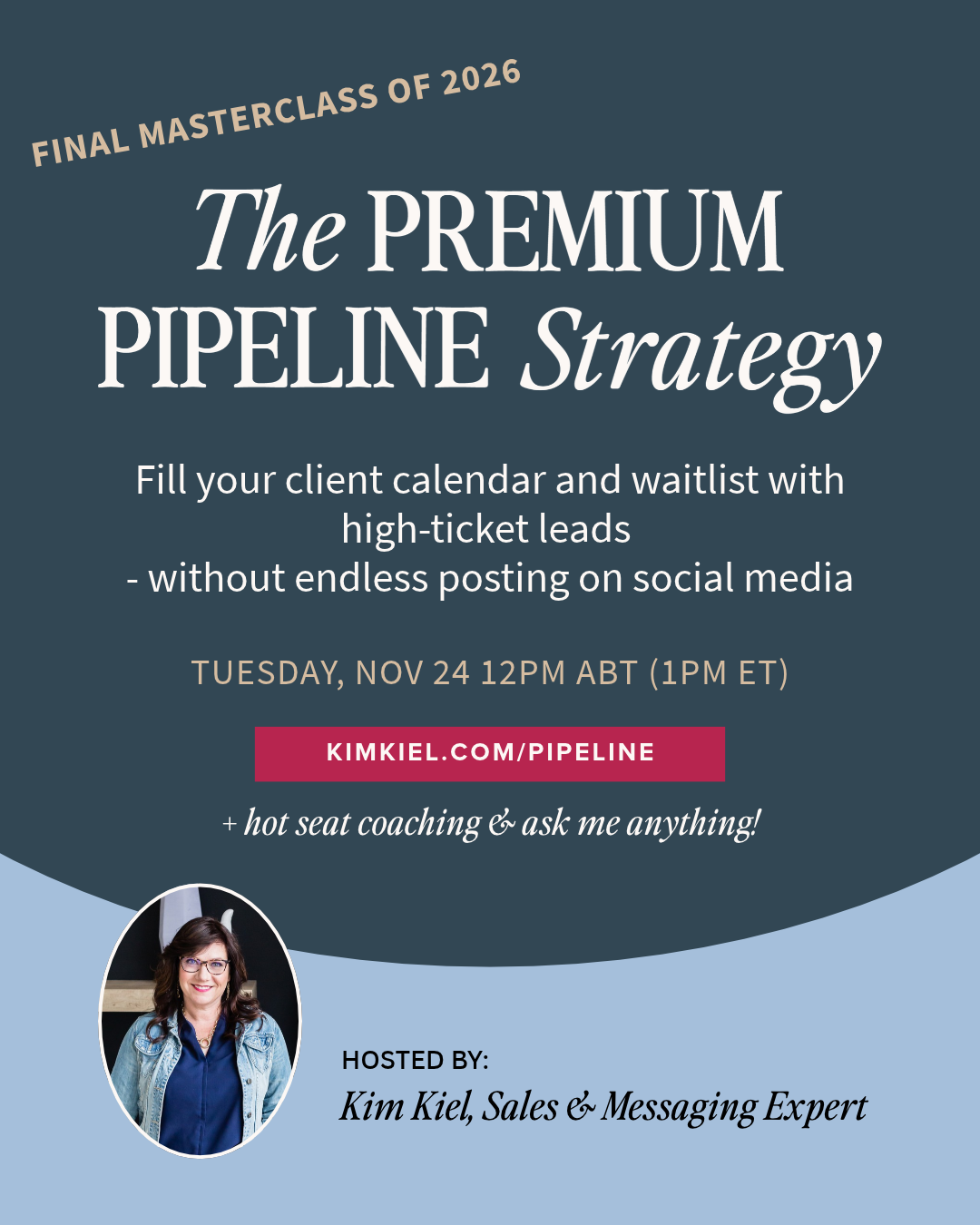
I'm going to host my final Premium Pipeline Strategy masterclass for 2026. It's on Tuesday, November 24. Grab your free seat at kimkiel.com/pipeline.
I'd love for you to come and see first-hand the masterclass that saw above industry-average conversion rates and a return on ad spend.
And of course, if you're thinking of joining Pivot to Premium, this will be your absolute last chance to join and lock in the 2026 rates before I increase them in 2027.
I'll also hold some time at the end of the masterclass to answer any questions you might have about how I ran this funnel, about Meta ads, or about running your business. You'll get kind of a two-fer: a masterclass and an Ask Me Anything session to close out the year.
See what the fuss is about! Attend my final masterclass of 2026, The Premium Pipeline Strategy: https://www.kimkiel.com/pipeline
-
[00:23] Kim: Hey there, welcome to episode 183. In this episode, I'm peeling back the curtain to share a strategy I used this year to grow my business. I'm going to share my actual numbers, actual costs, and revenue. I'm going to talk about what worked and what didn't to give you an honest breakdown of a popular sales strategy I used in my business this year.
[00:48] Kim: But before I do, I think it's important to acknowledge what is going on in the industry. We're in an era where a lot of us are feeling the pinch of the increased cost of living. I've personally changed my buying habits to help stretch our household dollars. I'm also being choosier in my business about where I invest.
[01:12] Kim: And many business owners I talk to have experienced a flattening of revenue. Sales are a little more sluggish and slow. And at the same time, there have been several massive launches in the online business world.
[01:28] Kim: Callan Faulkner, who teaches business owners how to integrate AI systems, famously had a $20.7 million launch in the spring of 2026. Jessi Jean, who sells a course on creating yapping videos on Instagram, ran two or maybe even three launches of her offer over 10 weeks in the summer and fall and generated $7.5 million.
[01:54] Kim: Jessica Carter, who created a Reels editing course, and then a course on launching digital offers, generated $1.15 million in two and a half months. And if I'm being honest, I've found all of this quite triggering, but in a different way.
[02:12] Kim: On the one hand, I love that these women are selling their hearts out, making great income and helping solve problems. It is evidence that there is an abundance of opportunity that still exists in 2026. And on the other hand, I look at my own business and wonder why haven't I had that level of success?
[02:37] Kim: The answer is, I haven't worked towards it. I don't yap on Instagram, I don't shoot b-roll, I don't want to take hours creating and editing social media content, I don't have a team of 70 people like Callan Faulkner. And that is a choice that I've made.
[02:52] Kim: I think it's great to see these examples of these women having massive success. I think it's also important to see what success looks like when you intentionally choose to run a lean, boutique, high-touch business like mine, where the dollar amounts are much smaller but the wins are no less meaningful.
[03:12] Kim: I think we need to normalize that success doesn't always look like a million-dollar launch. In fact, it is very rare. So today I want to share with you the best thing I did for my business in 2026. Drum roll please. It was using ads and webinars to grow my audience and sell an offer.
[03:34] Kim: I know. It is not fancy. It is not anything out of the ordinary. It is a good old webinar funnel. This year, I aimed to host a monthly webinar. It's something I've wanted to do for a very long time. I have taken multiple courses and coaching programs, spent literally tens of thousands of dollars learning how to do webinars.
[04:00] Kim: But when I was in those programs, I never actually executed on what I was learning. So, in January 2026, I decided enough was enough, it was time to do it. And so I launched a masterclass webinar called the Premium Pipeline Strategy. In that webinar I made an invitation to join my group messaging program, Pivot to Premium.
[04:23] Kim: So let me share the nitty-gritty with you. I'm gonna get a little nerdy with the numbers. I ended up running seven webinars in 2026. Now, my goal had been to run a monthly webinar, and I only ran seven, but it's because on the months I didn't run a webinar, I was engaged in another teaching opportunity, like a summit or a guest expert session. So about every month I had some kind of monthly marketing moment going on.
[04:53] Kim: But with this particular experiment, I ran Meta ads to cold audiences in the two weeks leading up to five of the seven webinars. The other two webinars I promoted to my email list only. And I have to say, I was pretty impressed with how effective my ads were.
[05:13] Kim: I took a look at the latest data and research, and the average cost per lead, meaning how much you're paying to acquire a lead or a prospect, is, across the industry, $27.66. And that is in U.S. dollars.
[05:30] Kim: Now, the average is across a range of industries, so restaurants are at the low end at about $3 per lead, and dentists and dental services is at the high end at $76.71 per lead. My masterclass and offer falls under the Education and Instruction category, which sees an average Meta ad cost per lead of $28.22.
[06:00] Kim: So, hold on to your period panties when I tell you what my cost per lead was. My costs ranged from $7.13 to $12.18 for an average of $8.49 per lead. But my costs are in Canadian currency. When I convert to U.S. dollars, my average cost per lead was $5.96. That is incredibly low.
[06:31] Kim: It's because I nailed the messaging and positioning in my ads. My ad copy really called in my ideal buyer. I was hyper-specific in both my targeting and in my ad copy that I work with Gen Xers who are frustrated with playing the social media game, who feel like the marketing advice doesn't work for them, and who know they should be generating way more revenue than they're generating.
[07:00] Kim: When people signed up for my masterclass, I included a question on the form that asks what led you to sign up today. And the responses I got affirmed that I was bang on in my targeting, because they wrote things like, "You're speaking my language," "I can't stand the advice out there," "Your ad really spoke to me," or "I know I'm not charging the rates I should be for my work." This kind of voice of customer told me that my message was landing.
[07:33] Kim: In terms of ad spend, I set a limit of about $1,000 to $1,500 per campaign. So for each webinar I hosted, I spent a thousand bucks on ads. In total, I spent $6,105.92 on ads, Meta ads in 2026, and that ended up bringing me around 100 to 200 sign-ups. The ads added about 837 people to my email list over the course of the year.
[08:12] Kim: Which begs the next question. How did my masterclass registration page convert? And I'm gonna be honest, I think it was okay. It was nothing crazy. Uh, my landing page converted at 28%, which means 28% of the people who clicked the ad went to my landing page and then signed up for the masterclass. 28% of the people who landed on that landing page opted in for the masterclass.
[08:42] Kim: And I honestly feel like that landing page could convert more. Remember, I'm selling this masterclass to a totally cold audience. These are people who've never heard of me before. When I compared my conversion rate with the industry average, my landing page conversion rate was actually pretty good. According to Leadpages, webinar registration pages for B2B audiences convert between 20 and 40% for well-targeted traffic. So at 28%, I'm kind of right in the middle.
[09:16] Kim: According to WordStream, conversion rates in the Education and Instruction category are 13%. So given that, I'm more than okay with my numbers, especially since this was my first attempt at running a webinar funnel with cold traffic. You can check out my landing page at kimkiel.com/pipeline. And while you're there, why don't you sign up for the last masterclass I'll be hosting this year.
[09:40] Kim: Now I think I could improve the design. I could definitely incorporate a stronger voice of customer and messaging, and maybe add a little more urgency that would increase those conversion rates. In marketing, everything is a test, so even though that's my average, and those averages are above average, I could still push it more.
[10:01] Kim: Okay, so we talked about ads, we talked about conversion rates to get people to register for the masterclass webinar. Now let's talk about sales. How many sales did I get? Well, I assure you it wasn't anywhere close to a million or even a hundred thousand dollars. I'm keeping it real, and I feel pretty vulnerable telling you that across all the webinars I hosted, I closed 7 sales.
[10:28] Kim: Wah-wah. I know, that sounds so low. But if you zoom out, it's also not that bad. Of the seven webinars I hosted, four of them generated sales, and those sales were with ideal premium clients. They brought in beautifully aligned clients who hopped on sales calls and were like, "I'm in."
[10:57] Kim: These are women who I feel lucky to work with because they are so niched in their expertise, who are so incredibly talented and who deliver such tremendous value to this world. And they chose to work with me to help them amp up their messaging and sales. And remember, many of these sales were with people who had never heard of me before they saw an ad.
[11:20] Kim: They clicked an ad, watched a webinar, and bought my high-ticket offer, which is priced at $2,000 for four months, or $4,800 for the full year. Those seven sales generated $33,800 for my business. That is not chump change! And remember, I only spent $6,105 on ads. That turned into $34,000 in revenue, which means I had a return on ad spend of 5.5. For every $1 I plugged into Meta, I received 5.5 times my money back. That's an insane return rate.
[12:06] Kim: For comparison, average ROAS, or return on ad spend, across all industries is around 2.8. In my category of education and training, the industry average is only 1.8. I feel pretty dang good about 5.5x-ing my investment in ads. Looking at these numbers now, I kind of wished I'd gone a little harder, invested more money in ads and hosted more masterclasses in 2026.
[12:40] Kim: But here's the thing I really want to share with you. These sales felt so easy. I found running and managing the ads was so easy and fun, and I will acknowledge and shout out my tech wingwoman Lacey, who did help me a lot with it. But delivering the product and service was also so easy and joyful. Working with clients inside Pivot to Premium is the work that lights me up the most.
[13:11] Kim: So not only was there a mathematical return on investment, a financial return on investment, there was also a massive ROI in terms of the joy and delight I felt for my business again. I felt like I was in control and taking action, even if I was, quote unquote, only running a monthly or a near-monthly webinar.
[13:33] Kim: So, what's my plan for 2027? Well, I'm not expecting to stop running ads or stop doing webinars. In fact, there's a pretty good likelihood I'll double down on that even more. I'm going to create a better sales page. I'm probably going to refresh the messaging and targeting and the registration page. And I'm also going to be increasing the fees to join Pivot to Premium.
[14:01] Kim: I haven't raised my rates to enroll in this program since 2024. And between the increased cost of running my business, like every single tech and tool subscription fee has increased, and not to mention the energy costs and overhead, like I have experienced all these increased fees, but I've held my rates the same since 2024. Not only that, but the level of coaching, training and strategy that goes into this community of Pivot to Premium is exceptional, and it has gone up over the years. So it's time for me to practice what I preach and raise my fees to join.
[14:44] Kim: Pivot to Premium absolutely delivers on its promise of shortening the path for women to attract premium clients and sell high-ticket offers. Which leads me to a final invitation for you. I'm going to host my final Premium Pipeline Strategy masterclass for 2026. It's on Tuesday, November 24. Grab your free seat at kimkiel.com/pipeline.
[15:11] Kim: I'd love for you to come and see first-hand the masterclass that saw above industry-average conversion rates and a return on ad spend. And of course, if you're thinking of joining Pivot to Premium, this will be your absolute last chance to join and lock in the 2026 rates before I increase them in 2027.
[15:33] Kim: I'm also going to hold some time at the end of the masterclass to answer any questions you might have about how I ran this funnel, any questions about Meta ads or any other strategies you might have, or questions you might have about running your business. You'll get kind of a two-fer, a masterclass and an Ask Me Anything session to close out the year. So please save your seat at the final Premium Pipeline Strategy masterclass of 2026. Visit kimkiel.com/pipeline.
[16:05] Kim: Well my friend, that's a wrap on this episode where I peeled back the curtain and gave you a peek at the real numbers of a real business, with a real woman running that business in 2026, the year of Our Lady Dolly Parton. If you found this helpful, please hit subscribe and follow and leave a rating and a review. It's a way you can support me so I can continue creating this podcast for you. Thank you so much for joining me today. I will see you again next week.
Let’s Connect
Follow & Review
Enjoy these tiny habits and quick-hit episodes? Follow or subscribe to the podcast and please leave a 5-star review!
You can do that on Apple Podcasts or Spotify! I read each of them, and they help me make sure I am providing the content you love to hear!
Plus, you get to pay it forward because it will allow other listeners like you to find the podcast!
