
179 | Stay Weird: Why Distinctive Brands Win Premium Clients
Stay weird: why being distinctive is your secret weapon for winning premium clients
Earlier this summer, my husband Chad and I went to a concert here in our city. It was for a kind of obscure band, so obscure he couldn't find anyone to go with him. They're not really my jam, but as someone who appreciates music and culture, I decided to be his plus one.
When we arrived, almost the entire audience was dressed in black and white polka dots. Chad and I had thrown on a little polka dotted attire at the last minute on a whim. He wore a shirt, I wore pants. But many fans went all out. Some painted their faces and arms with polka dot makeup. Some wore full-on head-to-toe costumes, which was a level of commitment I was not expecting.
Then the band came out, the music started, and everyone began to bounce and dance and do these coordinated hand gestures. I didn't know them, but I learned really fast so I could join in. Everyone was smiling and filled with pure joy. It was one of the funnest nights I've had in a long time, and my cheeks hurt from laughing so much.
The weirdest band on the planet is also one of the most successful
That band was Angine de Poitrine, a duo out of Quebec.
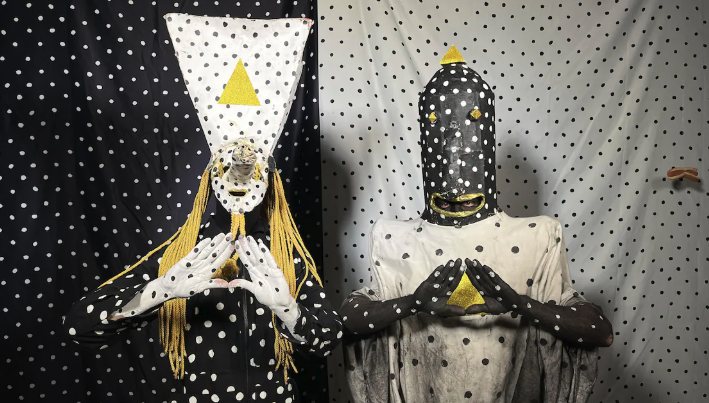
PHOTO CREDIT: Radio-Canada
They sing in an alien language they invented themselves. They wear head-to-toe polka dots with full papier-mâché masks featuring floppy noses that bounce and sway along with the music. Their sound is considered microtonal math rock, but it sits somewhere between Primus, prog rock, and the Yip Yip Martians from The Muppets.
They released their first album in 2024 and hit meteoric success in early 2026 after their KEXP performance went viral. They won Billboard's Global Breakthrough Award in June, drew the biggest Montreal Jazz Festival crowd since Stevie Wonder in 2009 (close to 200,000 people), and just made their late night TV debut on Jimmy Fallon.
I'd wager a big part of their rapid success is how truly weird they are. They neither sound nor look like any other band.
They're fresh and unique and definitely not AI-generated. And in a time when we're all tired of flaccid AI slop, from obvious AI writing to graphics that all look the same to soulless AI-generated music, we feel the difference when we experience something new and odd and uniquely human.
You don't have to be polished to sell premium
Many businesses and brands are afraid to be that kind of bold or to color outside the lines. There seems to be an unwritten rule that to be taken seriously in business, and certainly to sell premium or work with high-ticket clients, you have to be polished, buttoned up, smoothed over.
I want to challenge that. What I saw on that stage was two people who have clearly spent decades becoming masterful in their craft, putting that mastery on stage looking exactly like themselves. They were distinct and specific, and the market rewarded it.
The data says different wins
This tracks with real data.
The Saïd Business School at the University of Oxford studied 872 brands across multiple decades and categories. They found that difference was the number one brand factor that led to outsized share performance. Brands viewed as different are also viewed as brands worth paying more for.
Ipsos analyzed more than 2,000 video ads and found the same pattern. Ads built around strong, distinctive brand assets consistently outperformed the ones that played it safe.
And Louis Grenier, positioning expert and author of Stand the F*ck Out, studied the distinctiveness of 100 B2B tech brands across positioning, colors, logo, sound mark, taglines, and identity. Only one brand was truly distinctive. 78% were bland and generic, which means they're largely forgettable.
As he puts it, most of these brands are beige as f*ck.
Remove the brand name from the homepage and most customers couldn't tell them apart.
That's the lesson for all of us, especially if you're selling high-ticket offers.
Weird only works when it's backed by mastery
Being weird for weird's sake won't carry you to business success. Weird only works when there's mastery and depth underneath it. If Angine de Poitrine's musicianship was sloppy, they would just be a circus act.
The same goes for you.
Your version of weird, your specific voice, your point of view, your unique method, is an incredible asset. But only when it's paired with the depth of expertise you've already built.
We can't talk about depth of expertise and weirdness without talking about one of my personal icons, the recently departed Dolly Parton. I cried for a full hour when her death was announced. Dolly spent six decades looking exactly like Dolly: the big hair, the rhinestones, the nails, the bubbly and risqué persona. She made the jokes about her body long before anyone else got the chance.
But underneath all of that sat one of the most decorated songwriters in history, and a business empire that includes an amusement park, record labels, a film and TV production company, a museum, truck stops, a Broadway musical, food, beauty, home décor, fashion, and a literacy program that's put free books in the hands of millions of kids. She built an empire on being unmistakably herself at full volume, right up until the end.
Distinctive brands sell more (and charge more)
It's easy to see how weirdness pays off in music and the arts. Think Sia, Lil Nas X, Orville Peck, Cher, Cyndi Lauper, ZZ Top, David Bowie, André 3000, Grace Jones, and our Lord and Savior, Prince.
The same thread runs through business:
Liquid Death sells water in packaging that looks like nothing else on the shelf, at two to three times the price of generic bottled water.
Dr. Squatch turned the boring soap industry upside down by reaching a forgotten audience of preteen boys (ask me how I know). Unilever acquired them for $1.5 billion.
Duolingo uses an owl with an attitude as its mascot and has become the highest-grossing language learning platform, with a billion dollars in annual revenue compared to around $275 million for Babbel and $180 million for Rosetta Stone.
Skims built buzz and sales with its unique nipple bra.
How to find your weird without a million-dollar marketing team
You don't need a big marketing budget to leverage distinctiveness.
One version of my weird is that I love the Beastie Boys. I'm a super fan. I named this podcast after a Beastie Boys song. Random followers send me Beastie Boys memes and clips. When people think of the Beastie Boys, they think of me, and I kinda love that for myself.
I've also leaned into Gen X culture and serving a Gen X audience. A mentor recently told me he always thinks of me when something Gen X comes across his feed, and that I've done a great job claiming that category. You could also say selling premium high-ticket offers is my weird. It's what makes me unique among all the other copywriters and messaging strategists out there.
I do the same for my clients. One loves fly fishing and very nerdy board games, so I wove little references to those into his website copy. Those touches are memorable and help him stand out in the very boring, very beige field of engineering.
Another client sells premium bamboo baby clothing. Their agency-written copy sounded like every other babywear brand out there. It was very "Hey, Mama Bear." Too cutesy, and the founders are not cutesy. So in a VIP day, I dirtied up the copy and infused more of their fun, playful personality into the product descriptions, headlines, and calls to action. I brought out what makes them weird.
Stop toning yourself down
Many of us Gen X women were raised to be seen and not heard, to show up and shut up. We were socialized to look and act a certain way, and many of us spent decades in corporate or nonprofit environments where beige, boring corporate speak was beaten into us.
So when we launch businesses, we think we have to keep it toned down to sound "professional." We can't look sexy or goth or grungy or athletic or like we have a life outside our businesses.
But sister, if that's you, it has to stop. The research shows being weird and distinctive is the way to unlock more business success and attract your right-fit buyer.
Everything you downplay, your expertise, your methodology, your lived experience, your personality, your interests, your values, is what will actually attract and win premium clients.
Here's how to start:
Lead with what makes you human. Your values, your quirks, your interests, the things that make you a category of one and not an AI avatar.
Claim a unique niche or service and go all in.
Work with real creatives, like graphic designers and copywriters, who will build a standout brand for you. AI will edit out your unique voice and your edge and make you blend in with every other beige brand.
Let your freak flag fly, then deliver the best possible product or service to your buyers.
Be consistent. As Johnny McCarthy, global head of brand at Cadbury, says, do what others aren't doing and keep doing it consistently.
So stay weird, my friend. Stay weird.
Want more ways to attract high-ticket buyers? Join my free masterclass, The Premium Pipeline Strategy, at https://kimkiel.com/pipeline
-
00:27] I recently had one of the funnest, most joy-filled evenings in a long time. It was earlier this summer when my husband and I decided to go to a concert here in our city. It was for a kind of obscure band, so obscure he couldn't find anyone to go with him. I knew a little bit about the band. They're not really my jam, but as someone who appreciates music and culture, I decided to be his plus one. When we arrived at the concert, we were surprised to see almost the entire audience was dressed up in black and white polka dots, which is synonymous with this band.
[01:03] Now, Chad and I had decided at the last minute to put on a little polka dotted attire on a whim. He wore a shirt, I wore pants. But many fans went all out. Some painted their faces and arms with black and white polka dot makeup. Some wore full-on head-to-toe costumes, which was a level of commitment I was not expecting.
[01:24] Then the band came out, and the music started, and everyone in the concert hall began to bounce and dance and do these coordinated hand movements and gestures. Now, I don't know the hand gestures, and I didn't, but I learned really fast so I could join along. Everyone was smiling and happy and filled with pure joy.
[01:45] It was honestly one of the funnest nights I've had in a long time, and my cheeks hurt from laughing so much. That band, if you haven't figured it out already, was Angine de Poitrine, a band duo out of Quebec. They sing in a made-up alien language they invented themselves, so it's not French or English. They wear head-to-toe black and white polka dot combinations with full papier-mâché masks featuring floppy noses that bounce and sway along with the music.
[02:16] It's hysterical. Their sound is considered microtonal math rock, but it kind of sits somewhere between Primus, prog rock, and the Yip Yip Martians from The Muppets. Angine de Poitrine released their first album in 2024 and hit meteoric success in early 2026 after an appearance on the KEXP YouTube channel went viral. They won the Global Breakthrough Award from Billboard in June, and they recently made headlines for drawing the largest crowd Montreal Jazz Festival has seen since Stevie Wonder in 2009, which was close to 200,000 attendees.
[02:59] And earlier this week, they made their late night TV debut on Jimmy Fallon. I'll drop links in the show notes to some of these performances. Now, I'd wager a big part of their rapid success is because of how truly weird they are. They are not like anyone else. They neither sound nor look like any other band.
[03:20] They're fresh and unique and definitely not AI-generated. And in a time when we are all tired of flaccid AI slop, from obvious AI writing, to the graphics that all look the same, to the insipid, soulless AI-generated music, we feel a difference when we experience the new and odd and uniquely human. And at the same time, many businesses and brands are afraid to be that kind of bold or to color outside the lines.
[03:53] There seems to be an unwritten rule that's led us to believe that in order to be taken seriously in business, certainly to sell premium or work with high-ticket clients, you have to be polished, buttoned up, smoothed over. But I wanna challenge that today because what I saw on that stage was two people who have clearly spent decades becoming masterful in their craft, who put that mastery on stage looking exactly as them.
[04:21] They were distinct, specific, and the market has rewarded it. And this tracks with real data.
[04:28] The Saïd Business School at University of Oxford studied 872 brands across multiple decades and categories. They found that difference is the number one brand factor that led to outsized share performance or boosted the value of their shares. Brands viewed as different are also viewed as brands worth paying more for.
[04:55] Ipsos ran a similar analysis of more than 2,000 pieces of video advertising and found the same pattern. Ads built around strong, distinctive brand assets consistently outperformed the ones that played it safe.
[05:11] Louis Grenier, a positioning expert and author of Stand the Fuck Out, recently studied the distinctiveness of 100 B2B tech brands. He assessed different elements, including positioning, colors, logo, sound mark, taglines, and identity. He found that only one brand was truly distinctive and unique. 78% were bland and generic, which means they're largely all forgettable.
[05:40] As he puts it, 80% of the brands in the sample are beige as fuck. Remove their brand name from the homepage, and most customers wouldn't be able to tell them apart. He goes on to say, "There's a massive opportunity if you're willing to stand the fuck out." And that's the lesson for all of us, especially if you're selling high-ticket offers. But being weird for weird's sake won't carry you to business success or command more market share.
[06:07] Weird only works when there's a mastery and depth underneath it. If Jean de Poitrine's musicianship was sloppy, they would just be a circus act. And the same goes for you. Your version of weird, your specific voice, your point of view, your unique method is an incredible asset, but only when it's paired with the depth of expertise you already have built.
[06:31] And we can't have a conversation about depth of expertise and weirdness without talking about one of my personal icons, the recently departed Dolly Parton. Side note, I cried for a full hour when her death was announced. I am a lifelong fan of hers. Dolly spent six decades looking exactly like Dolly, the big hair, the rhinestones, the nails, the bubbly and risqué persona.
[06:58] She made the jokes about her body long before anyone else got a chance to. But underneath all of that sat one of the most decorated songwriters in history, and a business empire that includes an amusement park, record labels, a film and TV production company, a museum, a branded line of truck stops, a Broadway musical, food, beauty, home décor, fashion, a literacy program that's put free books in the hands of millions of kids, and a reported net worth well over half a billion dollars.
[07:37] She built an empire on being unmistakably herself at full volume right up until the end. Now, it's easy to see how weirdness and distinctiveness are leveraged in music and the arts. Think of Sia, Lil Nas X, Orville Peck, Cher, Cyndi Lauper, ZZ Top, David Bowie, André 3000, Grace Jones, and our Lord and Savior, Prince.
[08:04] The same thread of success can be found in business as well. Liquid Death sells water in packaging that looks like nothing else on the shelf, and it's two to three times more expensive than generic bottled water. Dr. Squatch turned the boring soap industry upside down, reaching an entirely forgotten audience of preteen males.
[08:29] Ask me how I know. Their distinctive branding was so successful, Unilever recently acquired them for $1.5 billion. Duolingo uses an owl with an attitude as its mascot, and it's become the highest grossing language learning platform with a billion dollars of annual revenue, compared to around $275 million for Babbel and $180 million for Rosetta Stone.
[08:59] And of course, Skims built buzz and sales with their unique nipple bra. But let's say you don't have a million dollar marketing team behind you. Let's look at how everyday entrepreneurs and small business owners can leverage weirdness and distinctiveness in our marketing and positioning.
[09:19] One version of my weird is the fact that I love the Beastie Boys. I'm a super fan. I named this podcast after a Beastie Boys song. I get random followers on the internet sending me Beastie Boys memes and clips. When people think of the Beastie Boys, they think of me, and I kinda love that for myself. I've also really leaned into Gen X culture and serving a Gen X audience.
[09:43] A mentor of mine recently shared that he always thinks of me when something Gen X comes across his feed. He said I've done a great job of claiming that unique category. And you could also say selling premium high-ticket offers is my weird. It's what makes me unique among all the other copywriters and messaging strategists out there.
[10:07] One of my clients really loves fly fishing and playing very nerdy board games. So I wrote little touches and references to that here and there on his website copy, because those things are memorable and help him connect and stand out in a very boring and very beige field of engineering. Another client who sells premium bamboo baby clothing came to me because their website copy was boring AF.
[10:37] They'd hired an agency to write it, and it just sounded too similar to all the other baby wear brands out there. It was very, "Hey, Mama Bear." It was too cuckoo and cutesy, and the founders are not cuckoo and cutesy. So they hired me for a VIP day to dirty up the poetic, cutesy copy and infuse more of their fun, playful personality into the clothing descriptions, the headlines, and the calls to action.
[11:06] I infused more of what makes them weird. So here's what I want to leave you with. Many of us Gen X women were raised to be seen and not heard, to show up and shut up. We were socialized to look and act a certain way, and many of us have decades of career experience working in corporate or nonprofit environments where beige, boring corporate speak was beaten into us.
[11:33] So when we launch businesses, we think we have to keep it toned down. We think we need to sound, quote-unquote, professional to be taken seriously. We can't look sexy or goth or grungy or athletic or like we have a life outside of our businesses. But sister, if that's you, it has to stop. The research and data show that being weird and distinctive is the way to unlock more business success and attract your right fit buyer.
[12:04] Everything you downplay, like your expertise, your unique methodology, your lived experience, your personality, interests, your values, these are the things that are actually going to attract and win premium clients. So lean into and express your unique voice and personality. Lead with your values, your quirks, your human interests, the things that make you a category of one, the things that make you a unique human and not an AI avatar.
[12:35] Claim a unique niche or service and go all in. Work with creatives like graphic designers or copywriters who will create a standout brand for you instead of using AI, which I promise will edit out all of your unique voice, your edge, and make you blend in with every other beige brand. Let your freak flag fly, and then deliver the best possible product or service to your buyers.
[13:03] And above all, be consistent in how you share that unique voice, your product, and your message. As Johnny McCarthy, the global head of brand at Cadbury says, "Do what others aren't doing and keep doing it consistently." So stay weird, my friend. Stay weird. Hey, thanks for joining me today. If you liked this episode, if you got any value from it, please leave a rating and a review.
[13:32] Share it with other small business owners who you think could stand to step out of the beige bland marketing and infuse a little more weird and wonderfulness into their brand. And don't forget to sign up for my next masterclass, The Premium Pipeline Strategy, where I'll walk you through even more elements to build a pipeline of premium buyers.
[13:52] To sign up for free, visit kimkiel.com/pipeline.
Let’s Connect
Follow & Review
Enjoy these tiny habits and quick-hit episodes? Follow or subscribe to the podcast and please leave a 5-star review!
You can do that on Apple Podcasts or Spotify! I read each of them, and they help me make sure I am providing the content you love to hear!
Plus, you get to pay it forward because it will allow other listeners like you to find the podcast!